
Affordable Printing Options for T-Shirts in Asia: Your Artwork, Our Print Tables
Five bars across a chest look simple, and that is exactly why they expose a printer. Parallel bars show every wobble: a screen a degree out, a platen a millimetre off, and the eye catches the fault before it can name it.
The bars here are printed as one locked set, registered within the same screen work, so the spacing your sample approves is the spacing every shirt in the run carries, size after size, wash after wash.
What follows on this page is the whole print decision in order: the garment piece by piece, the printing routes compared honestly, and the checks a printed shirt passes before its carton is allowed to close.
The Green Five Bar Print Tee, Part by Part
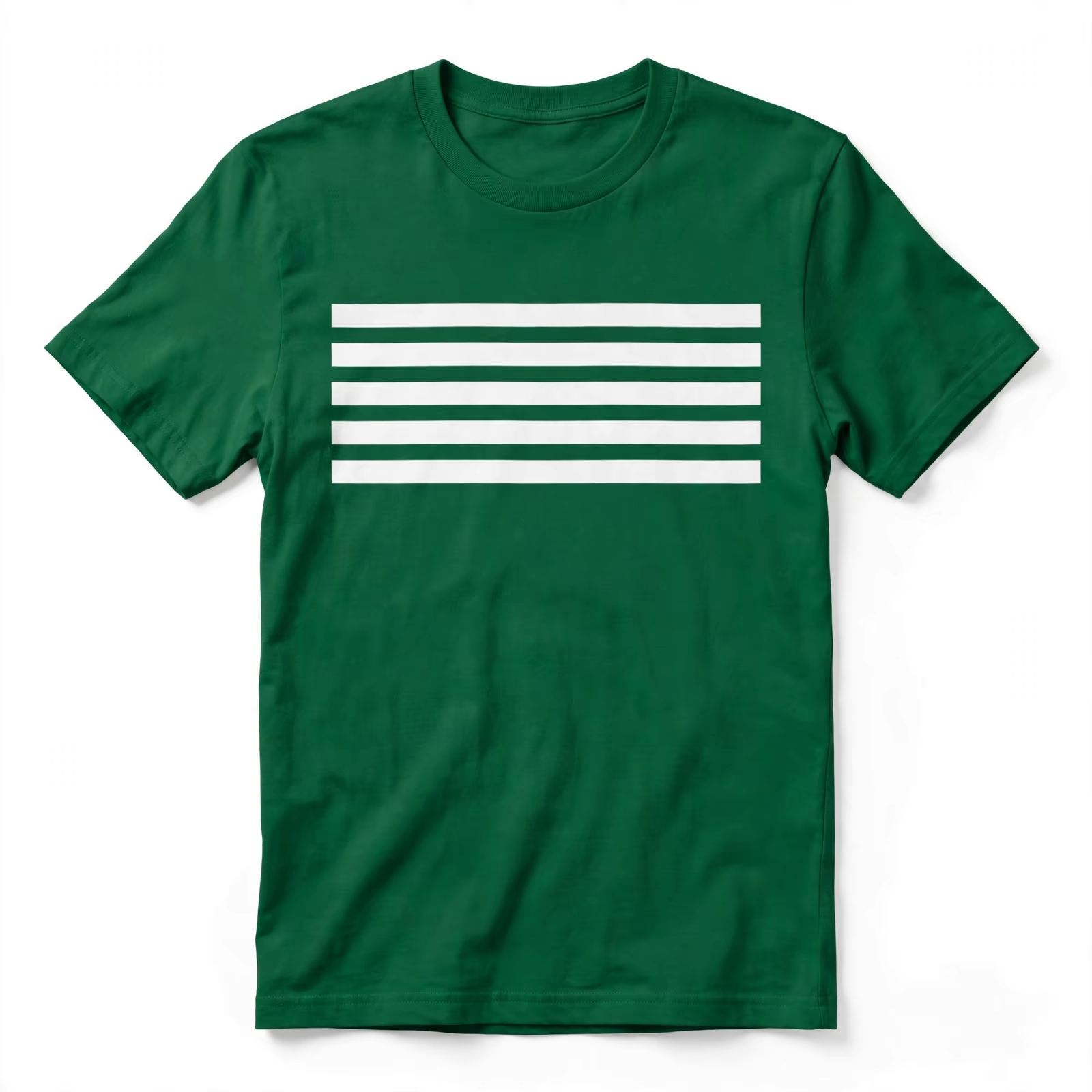
The front carries the print: five white bars across the chest of a kelly green crew tee, level, evenly spaced and flat on the cloth. It is the simplest possible test of a print shop, because a bar that waves, cracks or sits crooked has nowhere to hide.
The Five Bar Chest Print
The bars are printed in one pass family, each bar the same width and the same gap as its neighbours, centred on the chest where a buyer’s eye lands first. The print view in the gallery shows the ink sitting on the jersey with the knit running visibly under its edges.
- Five bars, even width and spacing
- Flat ink, no raised cracked edges
- Centred on the chest, level both sides
- Your artwork replaces the bars on your order
The Ribbed Crew Neck
The collar is a ribbed crew band, sewn to lie flat and recover after washing. The neckline view in the gallery shows the rib and the shoulder seam up close, which is where cheap tees usually give themselves away.
- Ribbed band holds the round shape
- Shoulder seams taped and even
- No sagging after the wash test
- Label sits centred inside the back neck
The Plain Back
The back is one clean green panel with no print, because many Asian retail programmes print the front only and keep the back for a clean silhouette. If your artwork needs a back print as well, it is added on the same build sheet at order stage.
- Plain back panel, centre seam free
- Same jersey, same shade as the front
- Back print available on your artwork
- Hem stitched straight and even
Printing Options Compared Honestly
Affordable does not mean one method forced on every design. The right print method depends on your artwork, your fabric and your run, and the cheapest quote is often the one that matched the method to the job instead of discounting the wrong one.
Screen printing carries bold, flat designs like these bars at the lowest cost per shirt once a run is under way. It suits solid colours, sharp edges and repeat orders, because the screens are made once and the same print comes back season after season.
- Screen print: flat colours, sharp edges, best on steady runs
- Direct to garment: many colours and fine detail, best on shorter runs
- Transfer print: small batches and names or numbers on demand
- Sublimation: all over colour on polyester sports styles
- Special finishes: puff, discharge and foil effects on request
Direct to garment printing earns its place when the artwork carries photographs or many colours and the run is short. Transfers answer the opposite problem: tiny batches, personalised names and last minute additions without setting up a screen at all.
T-Shirt Printing Manufacturer in Bangladesh for Asian Importers
Siatex prints and sews this tee in Bangladesh for importers across Asia who want European grade checking at Asian landed costs. The green bar shirt in the pictures is one buyer’s programme; your shirts carry your artwork, in your colours, on your chosen base shade.
Printed T-Shirt Supplier in Bangladesh Serving Kuala Lumpur Buyers
Malaysian buyers run event, retail and uniform programmes side by side, and they need one print partner who can move between them without changing quality. A flat chest print on a clean jersey base is the common ground, priced per shirt with the method matched to each design.
T-Shirt Printer in Bangladesh Shipping Towards Bangkok and Tokyo
Thai retail moves fast on graphic styles, while Japanese buyers check print edges and wash results harder than almost anyone. Both are served from the same discipline: an approved printed sample, locked screens or files, and bulk checked against that sample piece by piece.
Build Sheet for the Five Bar Print Tee
Every order starts from a build sheet agreed with you before cutting, so the bulk you receive is the sample you approved, repeated carefully. The sheet below shows the standard this tee is printed and sewn to; each line can be set to your level.
| Cloth | Single jersey with a smooth face for printing, at the weight your sample approves |
| Base shade | Kelly green in the pictures, or any ground colour you specify |
| Chest design | Five white bars as shown, or your own artwork set at your position |
| Printing route | Screen, DTG, transfer or sublimation, chosen against your artwork |
| Collar | Ribbed crew neckband with a flat, clean finish |
| Back panel | Left plain here, with a back print added when your design needs one |
| Neck label | Your brand’s woven label sewn inside the back of the neck |
| Size range | Built on your measurement chart and graded the way your buyers wear it |
| Carton packing | Each shirt folded into your printed polybag, cartons marked by shade and size |
A build sheet is a promise written down. When your second order comes, the same sheet and the same screens come off the file and the same shirt comes off the line, which is what makes a print programme feel dependable to the shops you supply.
Your Label Inside the Back Neck
The label picture in the gallery shows the inside of the back neck, where your woven label sits flat against the green jersey. It is sewn in during making, not added afterwards, so it survives every wash the shirt will ever see.
Alongside the label, your hangtag, your care wording and your polybag print complete the picture. A customer in Bangkok who picks the shirt up reads your name at every point, and the factory that printed it stays exactly where it should stay: out of sight.
- Neck label: woven with your brand name, stitched in while the collar is sewn
- Wash care: printed with the instructions and language you supply
- Swing tag: your design on the front, your price area left ready
- Bag print: your logo and your safety wording on every polybag
Print Checks Run Before Your Cartons Are Sealed
A printed shirt cannot come back for a crooked bar, so the checking happens while there is still time to fix things. Print position is measured on the first pieces off the table, and a wash test on a printed sample checks cracking and fade before the bulk is released.
The garment checks follow your approved sample: shade against the standard, measurements against your chart, collar and hem stitching, and the print pulled and rubbed by hand. Cartons are weighed and counted against the packing list before sealing.
- Print placement: first pieces off the table measured against the approved shirt
- Wash trial: a printed sample washed before bulk to test cracking and fade
- Ground shade: every batch compared with the standard under daylight light
- Carton count: pieces tallied against the packing list before the seal
The cure is tested, not assumed. A printed panel is stretched by hand at the table and read for cracking along the bars; a print that splits under a gentle pull goes back for curing time, because a crack that starts at our table finishes in your customer’s wash.
A Printed Sample in Your Own Artwork
The sample round is where your level becomes physical. Send your artwork file and your size chart, and the first shirt comes back carrying your design on the chest and your label in the neck, ready for you to wash, stretch and judge.
Most buyers test the sample the way their customers will: a wash, a stretch across the print, a check of the bars after drying. Your comments come back to the same table that printed it, and the bulk follows the corrected sample, not the first draft.
Sized the Way Asian Shops Sell
Asian retail often grades tees closer than Western programmes, with shorter body lengths in the smaller sizes. Your grading can follow your market exactly, with chest and length steps set from your own best selling sizes in Kuala Lumpur, Bangkok or Tokyo.
If your programme sells the same print to students and to office staff, the size run can stretch wider without changing the artwork. One design, one label, many wearers: that is what makes a printed tee worth its carton space.
The Reorder Is the Real Product
Any print shop can produce a first run. The product an importer actually buys is the reorder: the same green matched to the same standard, the same bars in the same position, the same measurements, arriving before the season peaks.
Your build sheet, your screens or print files and your approved sample stay on file here, so a reorder starts from certainty rather than memory. Retailers who find a print that sells rarely change it; our job is to make sure they never have a reason to.
One Print, Several Ground Colours
Kelly green leads this page because it photographs honestly and carries white print with real contrast, but a print programme usually runs wider. Buyers often pair the green with a rust, a sand and a charcoal base on the same artwork, building a rail that looks rich without risking unsold shades.
Because the pattern block and the print screens stay identical, a shopper who trusts the green can pick up the rust next visit without trying a new fit. Pick the shade story when you order; the print discipline behind it stays fixed.
One Artwork, Placed Right on Every Size
A print that sits perfectly on a medium can crowd the chest of a small or wander on an extra large. Placement here is set per size, measured from the collar seam on your approved sample, so the artwork keeps its position and its proportion through the whole run.
Your placement measurements are recorded with the artwork file, screen by screen. When the range adds a size, the new size is placed from those measurements and proofed on cloth before it joins the production table.
Chest, back and sleeve placements each carry their own measurement. A buyer approving one printed sample is approving the placement logic for every size the programme will ever run.
The placement record travels with the screens and the artwork file, kept together as one set. When the programme reorders a season or a year later, the same measurements set the artwork again, so the returning design sits exactly where its customers remember it, neither crept up the chest nor shrunk toward the hem.
Questions Asian Buyers Ask About T-Shirt Printing
Which print method is cheapest for a Kuala Lumpur retail programme?
For flat designs in a few colours on steady runs, screen printing is usually the most affordable per shirt. For many colours or short runs, direct to garment can cost less overall, because there are no screens to make. We quote the method against your artwork, not against a house favourite.
Can a Bangkok brand print its own artwork on this shirt?
Yes. The five bars are a sample design that proves the print quality; your order carries your artwork, in your colours, at your placement. The shirt is an OEM build, so your label, hangtag and packing carry the order as well.
How is print quality checked before shipping to Tokyo?
Print position is measured against the approved sample, a wash test checks cracking and fade before bulk release, and finished shirts are checked piece by piece. Cartons are then counted against the packing list before sealing.
Starting an Asian Print Programme the Right Way
Begin the way careful importers do: your artwork on one ground colour across your full size run, sold through a single season first. The sizes that clear tell you where the demand sits, and the second order follows those numbers instead of a guess.
When you are ready, send your artwork and chart through the contact page, compare this shirt with our quality t-shirt printing in Southeast Asia programme, the original DryBlend unisex printed t-shirt and our graphic t-shirt manufacturer in Bangladesh range, browse the wider t-shirts collection, and find our export profile through the International Trade Centre.