
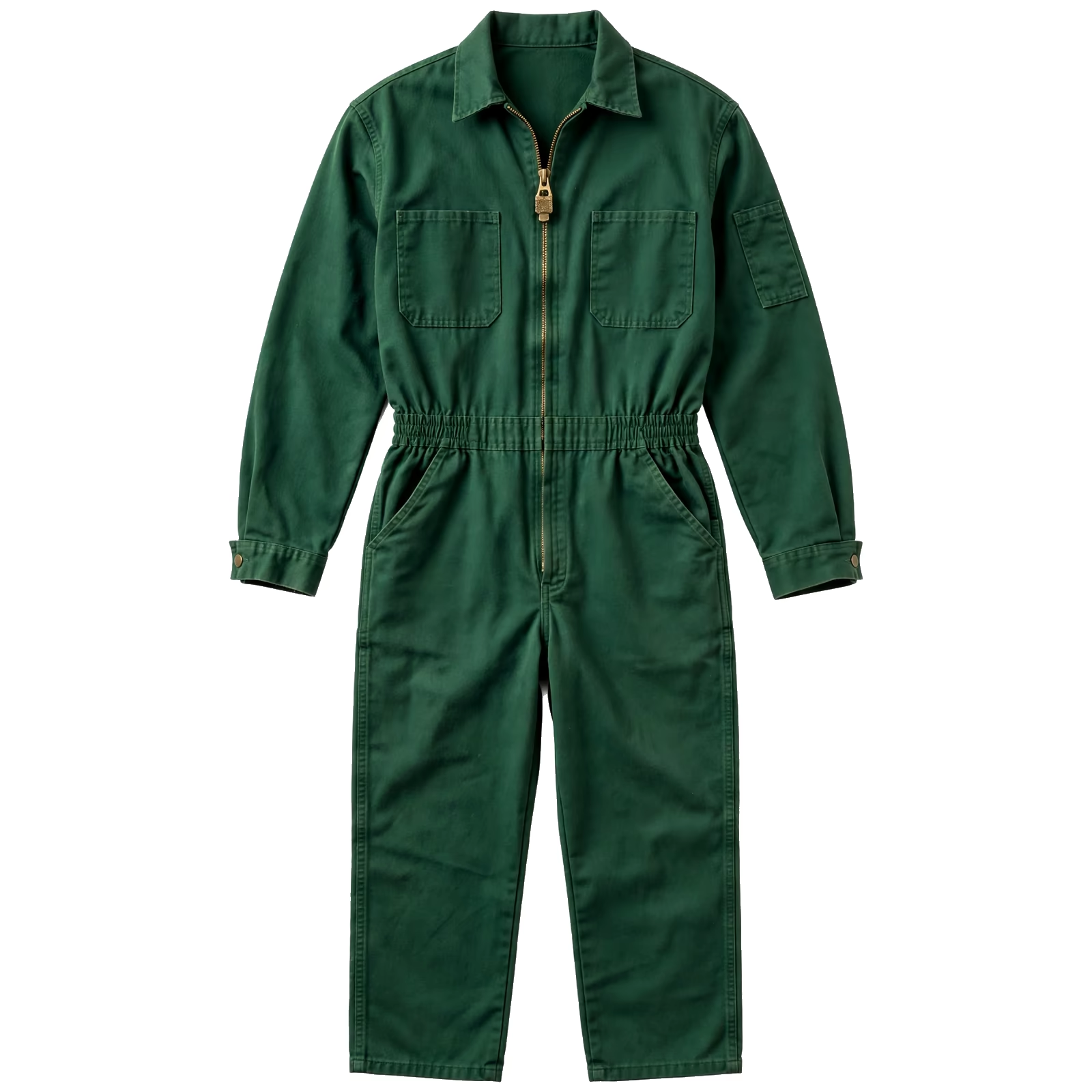
Bangladesh Workwear Manufacturers: Dark Green Coveralls Built for the Working Day
Dark green is the working colour of boiler rooms and loading bays for a practical reason: it carries a day’s grime without looking defeated, and it reads as one fleet colour across every site a company runs.
The shade here is fixed as an issue standard. Coveralls from different orders, issued months apart, stand together in one crew without the newest garment announcing itself.
Under the colour sits the real specification: a garment sewn to be worn hard, washed hot and repaired rather than replaced, which the rest of this page sets out piece by piece.
The Dark Green Coverall, Part by Part
Workwear buyers read a coverall the way its wearer will use it: zip first, waist second, pockets third. This garment was patterned to pass that reading in an importer’s inspection room, and then to pass the harder reading on the floor.
The Brass Zip and Collar
The front closes on a brass zip with a proper metal pull, set straight into a reinforced placket, and the shirt collar sits flat above it. The detail view shows the arrangement up close: even teeth, level stitching, and a chest pocket placed square beside the zip.
- Brass zip with a metal pull, set straight
- Placket reinforced along the full front
- Collar shaped to sit flat when zipped
- Chest pocket squared beside the zip
The Elasticated Waist and Back
The back waist is elasticated in a wide shirred band, so the garment gives when the wearer bends, climbs or lifts, and returns when he stands straight. Two patch pockets sit below the band, bartacked at the corners where pockets always tear first.
- Wide elastic band across the back waist
- Give for bending, lifting and climbing
- Two back patch pockets, bartacked corners
- Plain back panel ready for a company print
Legs, Cuffs and the Hem
The legs run straight to a plain hem that sits over a boot, as the hem view shows, with the twill’s edge stitching carried cleanly around the turn up. Sleeve cuffs close on a button, keeping the wrist covered and the sleeve clear of the machinery.
- Straight legs hemmed to sit over boots
- Button cuffs closing the wrist
- Seams stitched flat for strength
- Hem finished with a clean turn up
Bangladesh Workwear Manufacturers Sewing for Industrial Buyers
Siatex works as Bangladesh workwear manufacturers for importers who supply factories, fleets, farms and service crews. The dark green coverall in the pictures is one buyer’s specification; your order runs in your colours, with your label, your pockets and your tape placed where your industry asks for them.
Industrial buying runs on replacement cycles: garments retire on a schedule and the same specification must arrive again. Your build sheet, sealed sample and size chart stay on file here, so the replacement order is a rerun of an approved garment, not a new development.
Coverall Supplier in Bangladesh for Canadian and North American Programmes
North American workwear programmes span wide size runs and hard industrial washing. One pattern and one twill standard serve the whole contract, and cartons can be packed by size or by site, so a distributor’s warehouse sorts once, not twice.
Workwear Exporter in Bangladesh Shipping to the Gulf and Europe
Gulf and European buyers reorder against framework agreements, where the garment is specified once and called off for years. Your specification stays frozen on file, so a call off in year three matches the delivery in year one, stitch for stitch and shade for shade.
Build Sheet for the Dark Green Coverall
Buyers who shortlist Bangladesh workwear manufacturers are really shortlisting written standards: nothing on a workwear order is left to the machinist’s memory. The full make is written into a build sheet your side approves before cutting; this is the standard the pictured coverall is sewn to, and any line of it can move to your specification.
| Cloth | Cotton twill with a tight diagonal weave, at the weight your sample approves |
| Colour | Dark green as pictured, or your company shades |
| Front | Full length brass zip on a reinforced placket |
| Collar | Shirt collar sitting flat above the zip |
| Waist | Elasticated back waist in a wide shirred band |
| Pockets | Two chest, one sleeve, two back patch pockets |
| Cuffs | Button closing sleeve cuffs |
| Legs | Straight legs, plain hem over the boot |
| Neck label | Your woven label sewn inside the back of the neck |
| Packing | Folded into your polybag, cartons marked by size and site |
A written build sheet is what lets a buyer promise a workforce the same garment twice. When the replacement order matches the first delivery, nobody on the floor can tell old stock from new.
A Working Garment Carrying Your Name
The label view shows the inside of the back neck, where your woven label sits flat against the green twill. On a garment that will be issued, washed and reissued for years, that label is the one part of your branding the wearer sees every single day.
Your chest embroidery, your hangtag and your polybag artwork complete the branding set. Whether the coverall is issued in a Canadian workshop or a Gulf plant room, it speaks with your company’s name at every touchpoint.
- Inside the neck: your name on a woven label
- Above the pocket: your embroidery from your file
- On the tag: your artwork and care wording
- On the bag: your branding on every polybag
Checks Before a Coverall Earns Its Carton
Finished coveralls are zipped, buttoned and measured before they are folded: zip action along the full front, elastic recovery at the waist, pocket bartacks pulled hard, and every size checked against your chart from collar to hem.
A wash and wear trial runs before bulk release, because industrial laundry is the hardest test a work twill will ever meet. Cartons are counted against the packing list and marked by size before they are sealed.
- Zip action: full front travel tested on finished garments
- Waist recovery: elastic stretched and read for return
- Pocket strength: bartacks pulled at every corner
- Size audit: collar to hem measured against your chart
The zip is cycled, not glanced at. Every coverall’s front zip is run up and down under hand tension before folding; a slider that hesitates at the waist seam is replaced at the table, not discovered on a first shift.
Approve It on a Working Shift
A coverall should be approved in use: zipped up, bent in, driven in. The sample round sends the garment in your working sizes with your label inside, so your trial wearers judge the exact article your crews will be issued.
Their comments come back to the same table that sewed the sample. An inch at the leg or a pocket moved an inch costs a conversation now; after bulk cutting, the same change costs a contract.
Graded for Working Bodies
Coverall sizing fails when torso length is guessed: too short, and the garment pulls at every bend. Your grading here steps chest, waist, leg and torso separately through the run, so each size keeps its reach at the wrist and the ankle.
Because one block serves the whole contract, a wearer refitted after a size change keeps the same garment logic. Issue rooms notice that steadiness even when wearers never do.
Replacement Orders That Match the Issue Stock
Workwear is never bought once. Garments retire, crews grow, and the replacement order is where specifications quietly drift at most factories. Your build sheet, sealed sample and dye standard stay on file here, and every repeat run is checked against them before a carton closes.
The result is simple: new issue stock hangs beside last year’s garments with no visible difference, and your stores team manages one specification instead of several near matches.
Dark Green First, Fleet Colours After
Dark green leads this page because it is the colour working fleets reach for: it hides the day’s marks, reads professional at a customer’s door, and carries light coloured embroidery cleanly. Around it, your programme can run your fleet or company shades on the same pattern.
Every colour is approved as a dye standard on the same twill before it joins the range. The garment underneath never changes, so a crew can be reissued in a new shade without a new fitting round.
One Garment, Every Season on Site
A one piece coverall works across the calendar: over a tee shirt in summer, over thermals when the cold comes. The cut leaves room for that layering without ballooning, and the elastic waist keeps the fit honest over whatever is worn beneath.
For buyers, that range means one specification covers the year’s issues. Fewer styles in the store room, fewer size exchanges at the counter, and a garment the crew already trusts.
Choosing the Twill Weight for the Job
Not every crew works the same surface, so the twill weight is a choice, not a fixed line. Lighter twills serve indoor assembly and driving work, where the wearer sits as much as he lifts; heavier twills earn their place outdoors, on farms and in plant rooms where cloth meets metal all day.
Your sample round settles the weight in hand, dragged across the surfaces your crews actually work. Once it is sealed into the build sheet, every size and every reorder runs on the same cloth, so a garment issued in year two feels like the one it replaces.
Built to Be Repaired, Not Replaced
A coverall earns its keep for years when small damage stays small. Stress points here are bar tacked, seat and knee panels are sewn with seam allowances that let a repairer in, and every carton carries spare buttons matched to the garment.
Your maintenance team gets a simple repair note with the first delivery: which thread, which stitch, which points can be re-sewn without weakening the garment. A torn pocket becomes a ten minute repair instead of a written off unit.
Replacement orders then cover growth and new starters, not failures. The issue stock lasts longer, and the cost per wearing falls season after season.
Reinforcement is placed where working coveralls actually fail: pocket corners, crotch seams, cuff edges and the zip guard. Those points are specified on the build sheet with stitch counts, so a replacement garment carries the same reinforcement map as the first issue.
Each delivery also carries spare cloth patches in the garment’s own twill, cut from the same lot. A seat or knee repair then matches the coverall around it, instead of announcing itself in a neighbouring shade of green. The patches cost almost nothing and save whole garments.
Questions Workwear Buyers Ask About Coveralls
Can reflective tape be added for our industry?
Yes. Bangladesh workwear manufacturers who sew to a written standard will set reflective tape at the chest, arms and legs in the layout your safety standard asks for, and the sample round confirms the placement before bulk. Send your specification and it is written into the build sheet.
Can the zip be concealed or changed?
Yes. The brass zip can run exposed as pictured, sit under a storm flap, or be swapped for a two way set. The choice is fixed at sample stage, so every later order matches the first.
How are cartons packed for a multi site contract?
Cartons can be packed and marked by size, by site or by wearer list, so deliveries go straight to the right store room. Tell us the split your issue rooms work with and the packing follows it.
Workwear That Works as Hard as Its Wearer
Start with the sample on a real shift, settle the specification while changes are still cheap, and let the programme roll out on a frozen standard your crews can trust for years.
When you are ready, send your specification and size list through the contact page. As Bangladesh workwear manufacturers we invite you to compare this coverall with the men’s coveralls Canada programme it shares its pattern with, the workman coveralls, our men’s safety coverall manufacturer in Bangladesh page, the work wear pants supplier and manufacturer in Bangladesh range and coverall suppliers in Qatar, and find our export profile through the International Trade Centre.