
Men Underwear Boxer Shorts From Bangladesh Garments Factory: The Woven Staple
A woven boxer is judged at the fly and the waistband before it is judged anywhere else. The button fly here is sewn with a proper placket, not a decorative flap, and the button is stitched to stay through years of washing. The blue check is yarn-dyed, so the pattern lives in the cloth itself and cannot crack, peel or fade unevenly the way a printed check does.
The poplin is light but not thin: it holds the loose woven shape that makes a boxer comfortable while still folding flat into a multipack. A single sample pair, washed five times at home, tells a buyer more about this garment than any specification sheet can.
The Blue Check Boxer, Part by Part
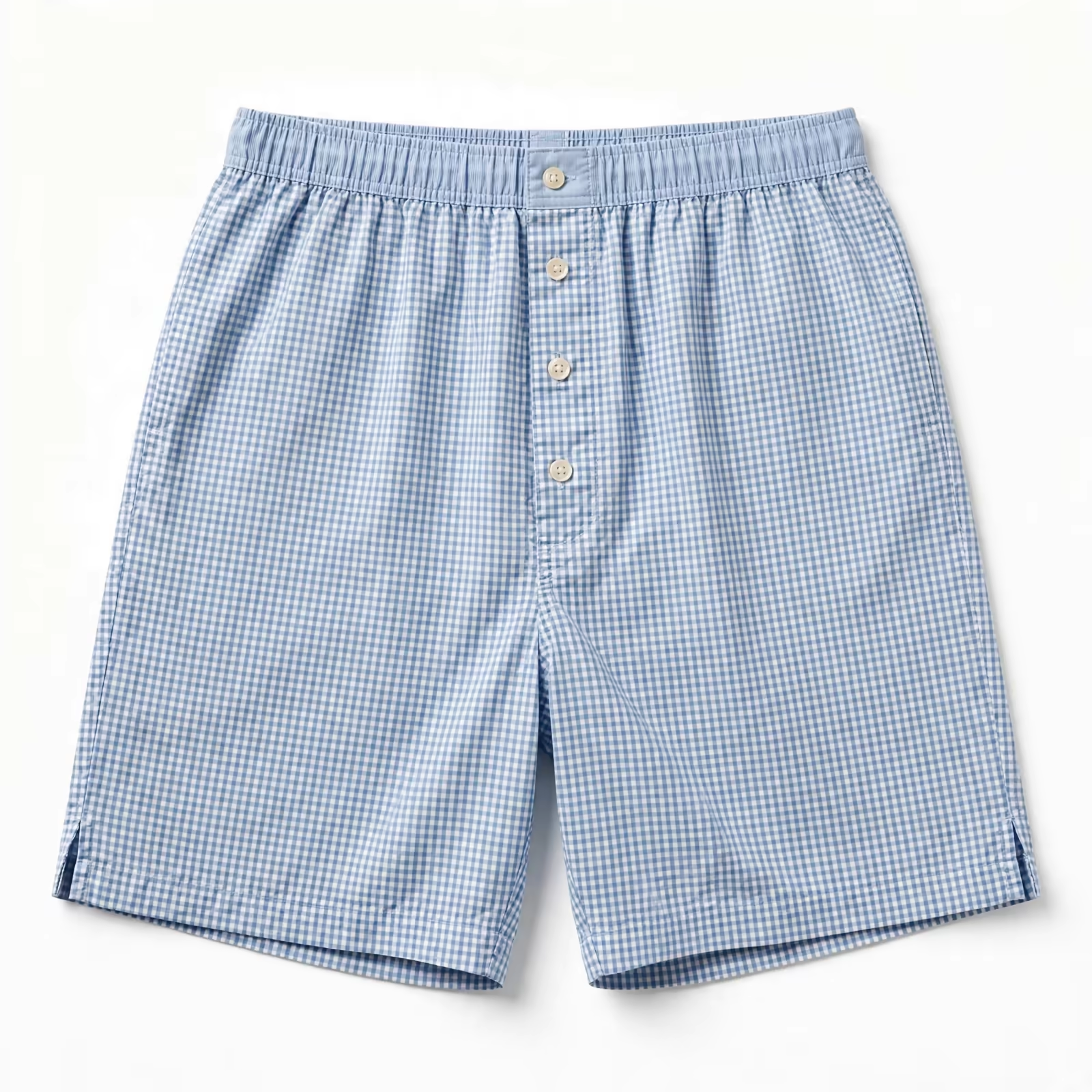
The front carries the button fly, four natural buttons running down a clean placket, and the gathered body falling from a light blue elasticated waistband. The check is small and even, the kind of pattern that sits quietly inside a range.
The back is one plain panel with a centre seam, cut loose so the boxer never pulls when the wearer sits. The leg hems are stitched flat, and each side finishes with a small vent where the panels meet.
- Cotton poplin with the check woven in the yarn
- Button fly with four natural buttons
- Elasticated waistband in a fabric casing
- Relaxed leg with stitched side vents
- Your label sewn inside the waistband
A Button Fly Is a Quality Signal, Not a Decoration
Cheap woven boxers skip the working fly and sew the front shut, because buttons and buttonholes cost time. This boxer keeps the full fly, and that choice tells a buyer more about the floor than any brochure: shortcuts are not where the saving is made.
The buttons are sewn to hold through the wash, and the placket is cut so the fly lies flat instead of gaping. A wearer notices a fly that works every single day, and a buyer building a staple cannot afford one that does not.
Woven Boxer Shorts Supplier in Bangladesh for USA Underwear Programmes
American underwear programmes run on multipacks and long seasons, and both punish inconsistency. A boxer that changes its waistband elastic between orders generates returns, and returns are what this build is organised to prevent.
The check, the elastic and the button are all specified in writing on the approved sample, and the bulk is sewn against that sample. What the USA buyer approves is what his warehouse receives, carton after carton.
- One written spec per style, held across seasons
- Multipack builds of two, three and five pairs
- Waist and leg measured on every size in the run
- Cartons packed for direct warehouse intake
Build Sheet for the Check Cotton Boxer
The build sheet below is the sample’s own record, the same sheet the bulk is sewn and checked against. Your programme changes any line of it, and the changed sheet becomes the standard.
| Fabric | Light cotton poplin, check woven in the yarn |
|---|---|
| Pattern | Small blue and white gingham check |
| Waistband | Elasticated, inside a fabric casing |
| Fly | Working button fly, four natural buttons |
| Fit | Relaxed woven fit, room through the leg |
| Leg finish | Stitched hem with a side vent on each leg |
| Label | Your woven label inside the waistband |
| Sizes | Cut to your measurement chart, S to XXL or your range |
| Packing | Singles or multipacks, built to your retail format |
The Waistband: Elastic Inside a Fabric Casing
On a woven boxer the waistband does the fitting, so it is built with care: the elastic runs inside a casing of the same poplin, gathered evenly, and its pull is tested relaxed and stretched against the chart. A band that digs or sags ends a staple faster than any print mistake.
Your label sits inside that waistband, sewn where the wearer sees it every morning. It is a small placement with an outsized job: it is the one part of the garment that carries your name into daily use.
Checks Run on Every Dozen Before Packing
Before a dozen is folded, the fly is worked by hand, button by button, and the waistband is stretched and released to feel for a dead section of elastic. Leg vents are checked for clean stitching, because a vent is where a woven boxer tears first.
The check pattern itself is read across the panels: the gingham lines should run true, and a panel cut off-grain shows at once. Pieces that fail are pulled at the table, not folded into the pack and left for the wearer to find.
- Fly worked by hand, every button tested
- Waistband stretch and recovery felt on each piece
- Check lines read for true grain across panels
- Side vents inspected for stitch strength
Boxer Shorts Wholesaler in Bangladesh for UK Multipack Ranges
British multipack ranges live on value, and value in underwear means the pair still fits after twenty washes. Poplin softens in the wash without losing its shape, which is why the woven boxer holds its place in UK ranges while fashion underwear rotates around it.
The pack build follows the retailer’s format: pairs folded to the pack size, the check shown at the window, sizes marked where the shopper looks. Your artwork and your label rules are followed to the letter, pack after pack.
How Multipacks Are Built and Priced
A multipack is priced as a build, not as loose pairs multiplied: the folding, the card, the window film and the outer all sit in the quote beside the sewing. The buyer sees those parts separately, so a change to the pack is a change he can price himself.
Mixed-check packs are a common build: the same boxer in the blue check, a stripe and a plain, folded as one set. Each variant is sewn to the same sheet, so the fit a customer trusts carries across the whole pack.
- Pack parts itemised in the quote, nothing buried
- Mixed designs folded as one retail set
- Every variant sewn to the same build sheet
- Size marking placed for the shopper, not the packer
Poplin That Washes Soft and Keeps Its Check
Because the check is woven rather than printed, washing cannot strip it: the blue stays in the yarn, and the cloth grows softer while the pattern holds. That is the quiet advantage a woven boxer carries over a printed one, and it is why the style survives in ranges for years.
The care label carries the wash guidance in your market’s wording. Buyers who run their own wash test on the sample will find the waist and leg measurements hold to the chart after washing, which is the result the whole build is aimed at.
One Check, a Whole Wall of Variants
A staple earns more when it anchors a small family: the same boxer in the blue check, a woven stripe and a plain dyed poplin, all cut from one pattern. The shopper who trusts the fit buys the second design without thinking, and the range grows without a new fit risk.
Each variant is sampled and approved on its own cloth, then sewn to the shared sheet. The waistband, fly and leg stay constant across the family, so only the cloth changes, and the buyer’s checking stays short on every reorder.
- Check, stripe and plain variants on one pattern
- Fit constant across the whole family
- Each cloth sampled and approved separately
- One build sheet behind every variant
The Sample Round for a Garment Men Reorder Blind
Underwear is bought on trust: a man reorders the boxer that fit, without trying the new one first. That makes the sample round for this style the most serious one in the range, because the approved sample becomes a promise the wearer relies on.
Wash the sample three times before judging it, and measure the waist against the chart after washing, not before. A band that holds its pull after the third wash is the band that keeps a customer, and that test is the one this floor expects a buyer to run.
What Makes a Check Pattern Safe for a Whole Range
A check is the safest pattern in underwear because it never dates. Stripes follow fashion and prints follow seasons, but a blue check has sat in men’s drawers for decades and will sit there for decades more. A range built on checks can reorder year after year without redesigning, which is worth more to a buyer than any single season’s novelty.
The check also hides the small realities of a woven garment: a slight softening of the cloth, a crease from the drawer, a shade that has relaxed half a tone after many washes. Plain colours show all of it; the check absorbs it gracefully, which is why check boxers earn fewer returns than plains in most programmes.
Scaling a Check Up or Down
The same colour story can run in a small check for a classic range and a larger check for a younger one, woven on the same poplin base. Both scales are cut from the buyer’s chosen design; the floor weaves the pattern at the size the range asks for.
More Underwear and Bottoms From This Floor
The same floor sews the bottoms these boxers sit beside in a range. Buyers building an underwear and loungewear wall often pair the woven boxer with the thermal underwear set for the cold season.
For the summer side of the wall, the bright blue shorts and the striped floral board shorts carry the same measurement discipline into outerwear.
The women’s side is covered by the women’s blue denim shorts, sewn to their own chart on the same floor. Trade buyers can also follow Bangladesh’s underwear exports through the International Trade Centre.
Cut Loose on Purpose: Why the Woven Fit Is Generous
A woven poplin has no stretch, so the fit is cut with the ease the cloth cannot give: room through the seat, a leg that hangs clear, and gathers at the waistband that let the boxer move with the wearer. Judged on the body, that generosity is the comfort men reorder for.
It also makes the size chart honest work: with no elastane to forgive a tight cut, the waist, hip and leg numbers must be right on their own. Your chart is followed exactly for that reason, and the sample is where any adjustment is settled.
Questions Buyers Ask About Woven Boxers
Can a USA buyer order the same check across two seasons?
Yes. The check is woven to a written yarn specification held on the style’s sheet, so the second season’s cloth is woven to the same blue and the same check size as the first. A yarn-dyed sample from the new lot is sent for approval before cutting.
Can a German buyer choose a different waistband elastic?
Yes. The elastic’s width, pull and casing fabric are all your call, written onto the build sheet once chosen. If your range runs a softer band for a comfort line, the same boxer is built with that band and checked against its own numbers.
Can a Canadian retailer build a mixed pack of checks and plains?
Yes. Mixed packs are a standard build here: variants are sewn to the same sheet, folded in your order and packed under your artwork. The fit stays identical across the variants, which is what makes a mixed pack safe to sell.
Starting a Boxer Programme the Right Way
Start with the sample in your own check and your own waistband, wash it, measure it, and wear it. A woven boxer is judged in the drawer, not on the rail, and one honest sample round settles everything a specification sheet argues about.
From that approved sample the programme writes itself: your check, your chart, your pack build, held in writing. Write through the contact page with your sizes and your pack format, and the first sample is cut against them.