
Coveralls Safety Uniforms Manufacturer Bangladesh: Built for Audited Workplaces
A safety coverall is not ordinary workwear with a confident name. It is issued under a safety system, checked by auditors, and worn in the places where clothing is part of the protection. This stone canvas coverall is built to that standard: a snap front that opens fast, seams that hold, and a specification that can be written into a safety file and then actually delivered.
Siatex Bangladesh Limited manufactures the full garment in Bangladesh, tape work and embroidery included where a programme specifies them. Buyers deal with the factory itself, so what the safety officer approves at sampling is what the crews receive, batch after batch.
Why a Snap Front Belongs on a Safety Garment
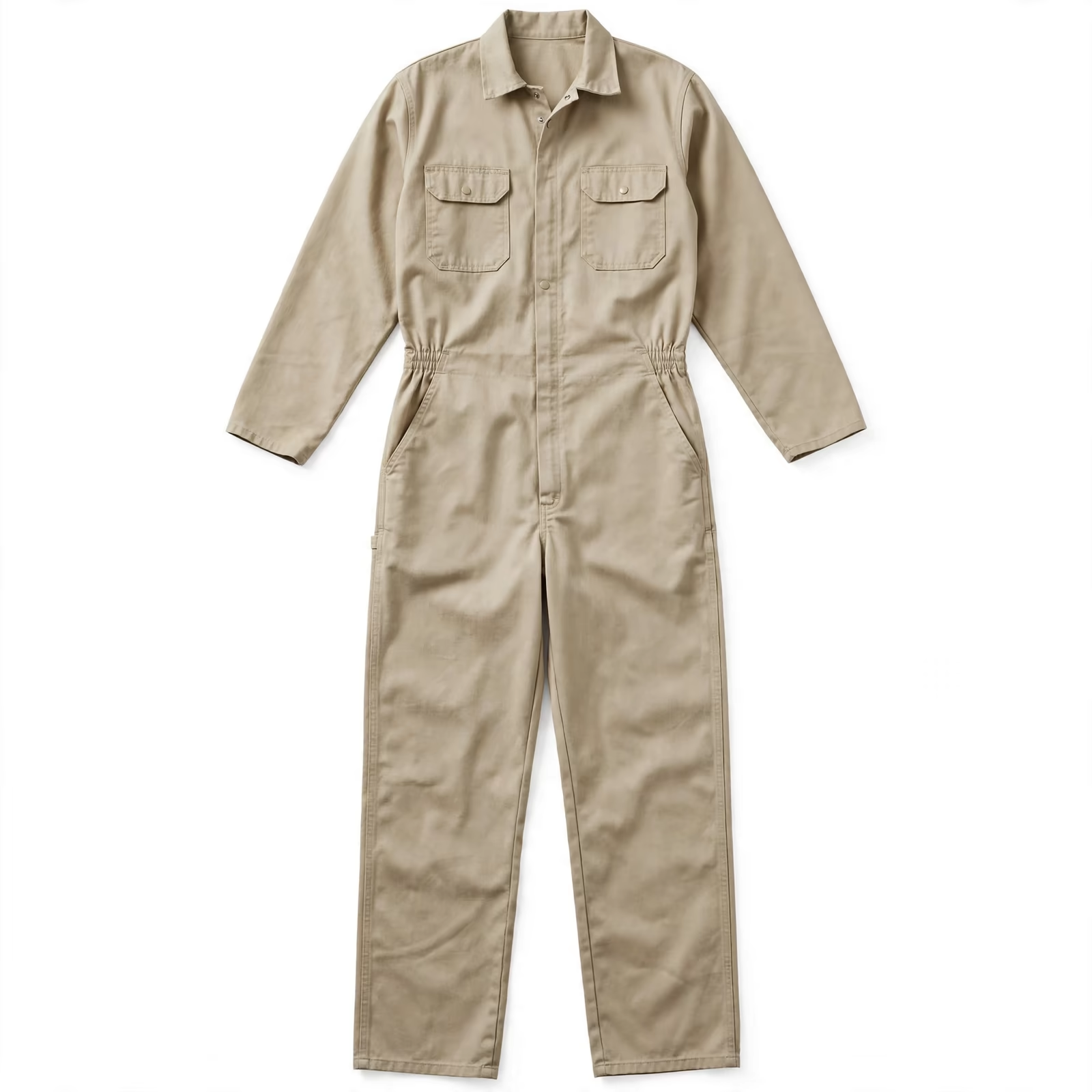
The detail view shows the front clearly: metal snaps down a reinforced stand, with the chest pocket beside it. Snaps open with one pull, which matters when a garment has to come off fast, and they cannot work loose the way a tired button can. For maintenance, utility and process work, that front is a safety feature, not a styling choice.
Canvas That Takes Abrasion
The fabric view shows the tight plain weave of the canvas. It resists the rubbing of harnesses, tool belts and machinery edges that eats lighter cloth, and it holds the garment’s shape so pockets and tape stay where the specification put them.
An Elastic Back Waist for Movement
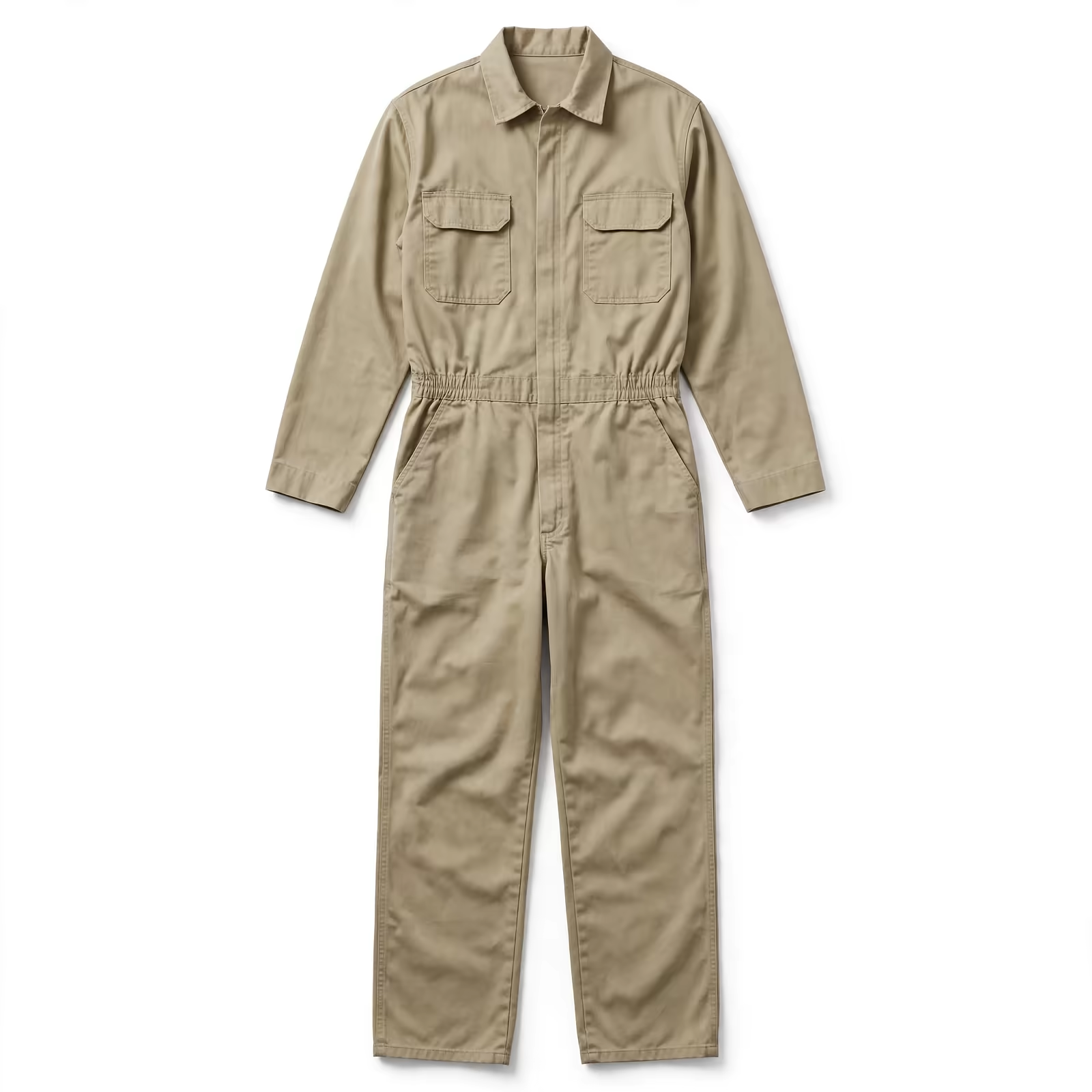
The back view shows the elasticated back waist: the suit gives when the wearer bends, reaches and climbs, while the front stays tidy for inspections and photographs. Movement room is a safety property too, because a suit that binds gets worn open, cut or left in the locker.
The Safety Coverall Part by Part
The close views show the parts a safety buyer checks: front closure, pockets, weave and the leg finish.
Collar, Front and Sleeves
- A snap-button front on a reinforced stand
- A shirt collar that sits flat under straps
- Long sleeves with clean, strong cuffs
Pockets, Waist and Back
- Two chest pockets for instruments and notes
- Deep side pockets, bartacked at the stress points
- An elastic back waist over a plain, strong back panel
Legs, Hems and Seams
- Straight legs with triple-stitched outseams
- Deep hems that survive dragging over boots
- No loose threads at any stress point
Where Safety Buyers Place This Coverall
Industrial plants, utilities, maintenance contractors and municipal services issue this class of suit wherever a workforce needs one audited garment. It serves as the base uniform under site-specific additions: tape layouts for visibility programmes, embroidery for company identity, and colourways for departments or contractors who must be told apart at a glance.
Plants, Utilities and Maintenance
For industrial programmes, the specification is everything: fabric, closure, pockets and tape written down and sampled before bulk. We build to that document and check production against it, so the audit trail from specification to delivered carton is clean.
Contractors Working Under Client Rules
Contractors often wear the client’s safety rules on someone else’s site. Programmes like this one let a contractor present one consistent, compliant garment across clients, with the embroidery changed and the safety specification held constant.
Build Sheet for This Safety Coverall
| Item | Specification |
|---|---|
| Style | Men’s safety work coverall, long sleeve |
| Colour | Stone, or your own programme colours |
| Fabric | Cotton canvas, tight plain weave |
| Front | Snap-button front, reinforced stand |
| Pockets | Two chest pockets, deep side pockets |
| Waist | Elastic back waist |
| Sizes | S to 3XL, tall fittings on request |
| Branding | Your woven neck label, tape and embroidery options |
| Origin | Made in Bangladesh |
Your Label Inside the Collar
The label view shows your woven label at the inside back neck. On a safety uniform the label does quiet administrative work: it identifies the issuing programme and the garment’s batch story every time the suit passes through the laundry, and it is sewn flat to survive that cycle for the garment’s whole life.
The size mark sits beside the label, so uniform stores can issue by size from a packed carton without unfolding a single suit.
Safety Checks Before an Order Ships
Safety garments are checked against their specification, not against a general standard: snap strength and alignment down the whole front, bartack integrity at every pocket corner, seam strength on the outseams, and measurements on every size. A suit that fails any point does not ship as a near miss; it does not ship.
Colour is checked across the whole order under standard light, because a safety programme that photographs as two shades in the client’s own audit pictures undermines the system it belongs to.
Samples Against Your Safety Specification
Sampling begins with your specification document: fabric, closure, pockets, tape layout and embroidery positions, built into one suit in your middle size. Your safety officer approves the physical garment against the paper, and only that approval releases bulk.
The measurements signed off there become the audit standard for production, size by size, and the approved sample travels with the order as its reference.
Tape, Colours and Programme Variants
Stone leads this programme as the neutral industrial base. The same block sews in the colours safety programmes actually use: royal for utilities, bottle green for grounds and estates, grey for engineering, and orange where a programme specifies it. Each colourway is checked as its own story.
Reflective tape layouts are built to your drawing: chest bands, sleeve and leg bands, or full configurations, sampled on the real garment so your safety officer judges placement on a body-shaped suit, not on a sketch.
Fit Notes for Protected Work
A safety coverall is worn over base clothing and under harnesses, vests and belts, so the block carries working ease at the chest, shoulder and seat. Tell us what your crews wear over and under the suit and the grading is set at sampling for that system.
Tall and short fittings run inside the same programme. A suit that drags at the ankle or binds at the shoulder is a hazard in itself, and fit is treated here as part of the safety specification.
Women’s Safety Fittings
Mixed workforces need the same specification on a women’s block, not a smaller men’s suit. Where your programme employs women in the same roles, the coverall is graded on its own block with the identical fabric, closure and tape standard, so the safety file covers one garment in two fittings.
Care That Survives Industrial Laundry
Safety suits are washed by contract laundries on industrial cycles. The canvas, snaps and elastic on this block are specified for that reality, and the care label gives the laundry plain guidance in the terms such contracts use.
Before bulk, washed samples from the production fabric are checked for shrinkage, snap function and shade, so the standard is proven in water, not just on the table.
Delivery Planning for Programme Starts
Safety programmes run to fixed dates: a plant turnaround, a contract mobilisation, an audit deadline. We plan production backwards from your date and confirm at order stage what the factory calendar holds, plainly and before commitment.
Cartons are marked by size and department where your programme needs it, with packing data sent ahead for your freight arrangements.
A Note on Cost for Safety Buyers
A safety garment is bought on cost per compliant month: a cheap suit that fails its first audit, or tears out of the programme in a season, costs more than this one in replacements, re-audits and credibility. The factory-direct price here buys the longer, documented service life.
We quote on the complete piece, tape work, embroidery, labels and programme packing included. If a change of fabric or tape layout would move the price, we show the effect at sampling, while the decision is still free.
Why Bangladesh for Safety Uniform Programmes
Bangladesh’s workwear lines build audited uniform programmes for industrial buyers across Europe, the Gulf and the Americas as daily business: canvas and twill stocks, reinforced seam capacity and export-grade checking at a cost that survives freight with margin to spare.
Siatex has made garments in Bangladesh since 1987. Safety coveralls are a core workwear line, and this stone suit is the current standard our industrial buyers reorder against.
How a Safety Order Runs, Step by Step
First, you send the safety specification, fabric and size chart. We return the sample suit for your safety officer’s approval before any bulk commitment. After approval, production runs with the checks described above, and packing follows your size and department split.
You receive the carton list before dispatch, set out size by size and colour by colour, so your stores know what arrives before the cartons open.
What We Need From You to Start
- Your safety specification, including tape layout where required
- Your fabric and colour for the programme
- Your crew size split, including tall, short and women’s fittings
Keeping the Programme Compliant Over Years
A safety programme outlives its first order: audits repeat, staff turn over, specifications are revised. Your block, fabric standard and tape drawings stay on record, so every reorder matches the audited original, and when your specification changes, the change is sampled and approved as a new standard rather than drifting in unnoticed.
That record keeping is the unglamorous core of safety supply, and it is what separates a uniform programme from a series of unrelated purchases.
What Auditors Actually Look At
An experienced auditor reads a coverall the way a buyer reads a sample: closure first, then the stress points, then the inside. Snaps that sit straight down a reinforced stand, bartacks that have not frayed at the pocket corners, seams without a skipped stitch: those details tell the auditor whether the safety file describes the garment in front of them or merely wishes it did.
Programmes built on this block pass that reading because the garment was specified, sampled and checked in the same order the auditor walks. When the paperwork and the suit agree, audits become a formality instead of an argument, and the safety team’s time goes back to the hazards that matter more than clothing.
Incident Readiness Starts in the Locker Room
The snap front earns its place on the worst day, not the average one: a garment that opens with one pull when it has to. Programmes choose this block for that property and then discover the everyday benefits, a front that never loses a button into machinery and never gaps under a harness.
Questions Safety Buyers Ask
Can you build to our written safety specification?
Yes. Send the specification and the sample is built to it point by point, for your safety officer’s approval before bulk. Production is then checked against the same document.
Are the snaps strong enough for daily industrial use?
Yes. The snap front is set on a reinforced stand, function tested on washed samples before bulk, and checked down the whole front at final inspection.
Do you supply women’s fittings on the same standard?
Yes. The same fabric, closure and tape standard is graded on a women’s block, so one safety file covers the whole workforce.
Build Your Safety Uniform Programme
Set this suit beside our other workwear stories: coverall in Saudi Arabia from Bangladesh workwear manufacturer, Bangladesh workwear manufacturers and the cargo pant supplier in Costa Rica. For regional trade background, see the International Trade Centre.
Send your safety specification, fabric and crew sizes through our contact page. We will make it at your level: your quality, your fabric, your design, your measurement, and your crews will wear a uniform your auditors can stand behind.