
Custom Mens Ice Hockey Jersey Manufacturer in Bangladesh for Teams and League Buyers Worldwide
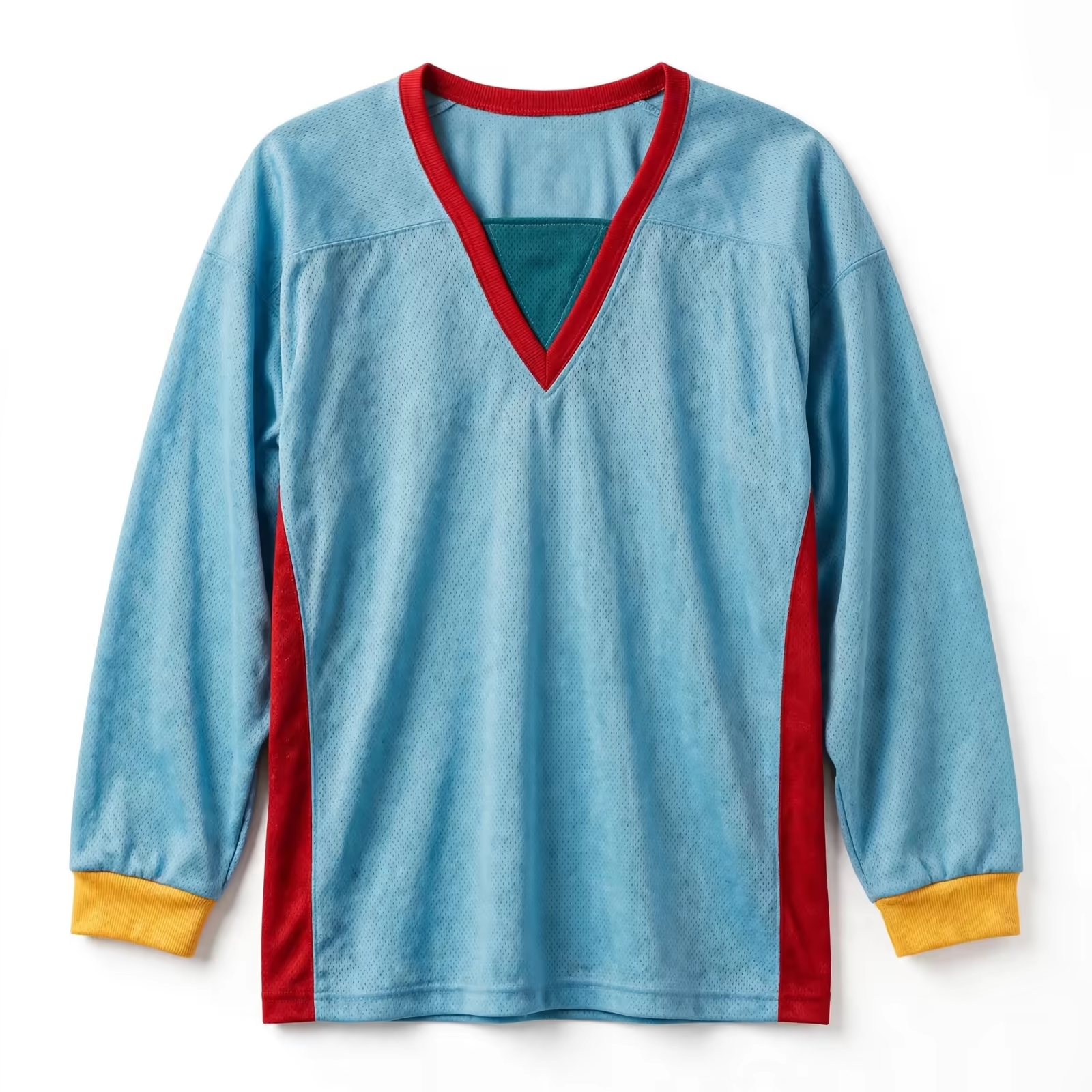
An ice hockey jersey is worn over armour, and that one fact shapes everything about it. The body must be wide enough to move over shoulder pads without riding up, the sleeves long and loose enough for elbow pads and a full slapshot swing, and the cloth light enough that a player forgets it by the second period. This jersey is cut to that brief, in a light blue mesh that breathes through the whole game.
The colour story is bold and simple: aqua blue body, red at the neck and down the sides, a teal flash inside the V, and yellow-gold at the cuffs. Four colours sounds like a lot until they are on the ice, where they read as one clean team identity from the far boards.
The Light Blue Jersey, Part by Part
The body is a boxy, hip-length cut with a straight hem, the traditional game shape that sits over pads and stays tucked in spirit even when it works loose. The mesh is a knitted hockey cloth with an open, airy structure you can see in the fabric view: it is the ventilation system of the jersey, not a decoration.
Red side panels run from under the arm to the hem on both sides. They give the jersey its side profile on the ice and carry the second team colour where television and spectators actually see it, in motion, at the sides.
A V-Neck Built to Pull Over a Helmet
The neck is a deep V bound in red rib, with a teal inset filling the point. The V is not a fashion choice: it is how a jersey goes on and off over a helmet and pads quickly in a changing room. The binding is stitched to stretch for that pull and settle back flat afterwards.
Mesh That Breathes Over Pads
Pads trap heat, and a jersey that seals it in makes the third period feel twice as long. The open mesh on this body lets air move through the cloth itself, so the layer over the pads works with the player’s own cooling instead of against it.
The mesh is knitted to hold its shape under that use. A loose knit that bags at the elbows and sags at the hem looks tired by Christmas; this cloth is specified to keep the boxy line through a season of games and washes.
Ice Hockey Jersey Supplier in Bangladesh for USA League Programmes
American leagues and school programmes order jerseys in roster quantities, home and away sets, with a size curve that runs heavy through the middle sizes and a goalie cut at the top of the run. This floor cuts that curve from the buyer’s own chart, so the set that arrives matches the roster that was measured.
Programmes dressing several age groups can run the same colour story across every group under one order and one spec. The pattern grades change with the group; the colours, the cloth and the checks stay constant, so the whole club photographs as one organisation.
Sizing and Grading for Players and Goalies
Sizes run from S to 3XL on the buyer’s measurement chart, graded generously through the chest and sleeve because the jersey dresses equipment, not just a body. Length is set to cover the pads and the top of the pants without swamping a smaller player.
Each size is sampled and measured before the run, and the approved measurements are what the checkers hold production to. A jersey that drifts small over pads is a jersey that comes back, so the drift is caught at the table.
The Goalie Cut Is Its Own Pattern
Goalies are not just the biggest size on the chart. The goalie cut carries extra width through the body and arm for the chest protector and blocker movement, and it is patterned separately here, then graded on its own numbers inside the same colour story.
How Each Dozen Is Checked Before Packing
Checkers work the jerseys in dozens. Necks are stretched and released to prove the binding recovers, sleeves are matched in pairs for length and cuff colour, side panels are checked left against right, and the mesh is held to the light for knitting faults.
Colour is checked under daylight lamps: blue against the approved swatch, red against its own, the teal inset and the gold cuffs against theirs. A four-colour jersey has four ways to be wrong, so all four are checked on every dozen before it is sealed.
Team Colours: One Pattern, Your Club’s Colours
Light blue, red, teal and gold is the sample story, not the limit. The same pattern takes any colour story a team skates in: body, binding, panels, inset and cuffs are each set by the buyer’s swatches, so a club’s identity is built into the cloth and panels rather than printed onto them.
That matters over seasons. Printed colours crack and fade at different rates and a two-year-old jersey stops matching a new one; panel and binding colours are the cloth itself, so a top-up order skates out looking like the original set.
Ice Hockey Jersey Wholesaler in Bangladesh for UK Teamwear Shops
British teamwear shops serving ice hockey clubs deal in small, loyal rosters that reorder the same jersey for years. This floor keeps the approved pattern, cloth and swatches on the club’s file, so a reorder runs to the first order’s standard without a fresh approval round.
Shops can build the hockey order alongside other team sports from the same floor, including our bus green and red hockey shorts for the field hockey wall and the red mesh basketball singlet for the court, so one supplier covers the whole teamwear rail.
More Sportswear From This Floor
The same floor makes the royal blue and red boxing jersey, the royal blue and coral cycling set and the red printed Australian football singlet, each built to its buyer’s chart and colours. Buyers comparing sourcing markets can also read the trade figures published by the International Trade Centre, which tracks Bangladesh among the world’s leading apparel exporters.
Why the Cuffs Are Yellow-Gold
The gold cuff is the smallest colour on the jersey and the one that does the most work. It finishes the sleeve with a flash that reads at distance, it ties the jersey to the gold in many club crests, and it marks the wrist, which is where a spectator’s eye follows the stick work.
Practically, a coloured cuff also hides the hardest wear on the garment. Cuffs rub gloves, sticks and boards for a season; a deep gold shows that life far less than the light blue would, so the jersey looks newer for longer.
The Sample Jersey: What to Test at Practice
One sample jersey, worn at a full practice over real pads, tells a buyer almost everything. Check the swing with a stick, the neck over a helmet, the mesh after an hour of skating, and the colours after the wash. If the sample survives practice, the run will survive the season.
The sample also fixes the crest position and the exact V depth on the club’s own chart. Everything the coach approves on that jersey is written into the order, so production has nothing left to guess when the roster set is cut.
Home and Away Sets From One Pattern
Most teams skate in two stories: a light set and a dark set, swapping the body and panel colours while the pattern stays identical. Running both sets from one pattern on this floor means the fit a player knows at home is the fit he gets away, and the two sets can be sampled, checked and packed inside one order.
The colour file holds both stories side by side, with the binding, inset and cuff colours written for each. When a mid-season replacement is needed, the file says exactly which story and which size, so a single new jersey matches the set it joins.
Numbers and Names: Planning the Back of the Jersey
A roster’s numbers are planned before the run, not after it. The buyer sends the squad list with numbers and sizes together, and each jersey is made for its line on that list. Spares are cut in the popular sizes without numbers, ready to be numbered when a call-up comes.
Number size and placement follow the league’s own rules where a league has them, or the club’s existing jerseys where it does not. The sample carries the captain’s number at full size, so the club approves the real proportions on the real cloth.
Caring for Mesh Jerseys Through a Season
Mesh asks for two things: a cool wash and air to dry. The colours on this jersey are in the cloth and panels, so they take normal team laundry without special handling, and the binding and cuffs are specified to keep their recovery through a season of weekly washes.
Kit managers who hang jerseys to dry rather than tumbling them get the longest life from the mesh, and the boxy cut keeps its line best stored folded or on a wide hanger. Small care notes like these travel with the order when a club asks for them.
For League Buyers: One Order, Many Teams
A league buyer dressing eight teams at once needs the opposite of eight separate orders. On this floor the whole league runs inside one production file: one pattern, one cloth, one set of checks, with each team’s colour story and roster list as its own section. Deliveries can still be split team by team, packed and labelled per club.
That structure is what keeps a league looking like a league. Every team takes the ice in the same quality of jersey, the same fit over pads and the same standard of finish, while the colours keep each club’s own identity. When a new team joins the next season, its story is added to the same file and cut to the same standard.
Questions Hockey Teams Ask Before Ordering
Can the jersey carry our crest and numbers?
Yes. The chest and back are kept clean for them, and they are applied to your artwork, sizes and placements. The sample jersey shows them exactly as the run will carry them, so the club approves the real garment, not a drawing.
Do you make a ladies’ cut on the same colours?
Yes. The same colour story is cut on a ladies’ pattern with its own grading, so a mixed programme dresses as one team. Both cuts can run inside a single order under one colour file.
How are the jerseys packed for a team order?
Jerseys are folded flat and packed by size, each bundle labelled, so a kit manager can hand them out by the roster list in minutes. Cartons follow the buyer’s own packing instruction when a league or shop has one.
Quoting an Ice Hockey Jersey Order for Your Team
Send the colours, the sizes and the rough quantity your roster needs, and the quote comes back worked out on those inputs. A photograph of your current jerseys is reference enough to start from if you want the same cut and colours.
Samples run first, in your colours and your crest position, so the club judges cloth, colour and fit over pads on a real jersey. Once the sample is approved, production follows the same spec the sample proved, and reorders run on the same file for as long as the team skates in those colours.
That file is also where a club’s history lives: the season a colour changed, the year the crest moved, the sizes the roster grew into. A buyer who stays with one floor builds that record once and never has to reconstruct it from old emails and photographs again, and every reorder starts from proof instead of from memory.
Send the roster list with the first enquiry if you have it; the quote and the sample both come back sharper when the sizes are real from the start.